waste less

A workspace in which agents work alongside the shift. Each agent covers one source of loss in the plant: it reads the systems that are already there, compares what is running against the best run of the same product, and posts what it finds where the responsible people already work. It proposes; named people approve; only then does it write. Every step is logged, and everything runs on your infrastructure.

01

use cases and value

Losses in a plant are rarely one large thing. They are many small, recurring ones: a hood that runs with too much supply air after a repair, a refiner set to a safety margin nobody has revisited, a vacuum pump that keeps running through a web break, a grade change that takes twelve minutes longer because three steps are not in the recipe. Each is a few percent. Nobody has the capacity to chase them all.

That is the work the agents take on. Each one is specialised on a single source of loss, knows which systems to read, what the reference is, and to whom a proposal has to go. The examples below are the agents of the demo plant, a paper mill with two machines, stock preparation and a combined heat and power unit.

  • Drying agentdaily 06:00 · on mention
    Steam per tonne of the running grade against the golden run, the best 24-hour run of the same grade in the last 90 days. Attributes deviations to hood, dryness after the press, steam pressure per dryer group, moisture profile. Proposes setpoints with effect in t steam/t and €/a.
    Hood PM 3 after flap repair+22 % supply air, 1.42 instead of 1.31 t/t. Proposal −8 % supply air → ≈ 41,000 €/a
  • Web break agenton every break · weekly ranking Fri 07:30
    Within an hour of each break: the most likely cause with probability, from DCS events, QCS profiles, camera images from the 60 seconds before the break and the lab. Confirmed by the shift in the thread, never by the agent. Ranks recurring patterns over the week.
    Week 36: 4 of 9 breaksedge cracks after manual trimmer adjustment at grade change → trimmer position into every change recipe, ≈ 9,600 €/week avoidable
  • Grade change agenton MES weekly plan · after every change
    Proposes a sequence with as few and as small jumps as possible while delivery dates hold. Measures every change against the best historical change of the same combination: time to on-spec, transition broke.
    Week 37: 6 instead of 8 changesRecipe v7 with ramp, hood lead and trimmer: −12 min, −2.4 t per change
  • Stock agentWed 14:00 · on mention
    Specific refining energy per refiner and grade against the strength target instead of a safety margin; chemical dosing against wet-end measurements; fibre losses via rejects and effluent. Every setpoint names the lab values that carry it.
    Refiner R2: 145 → 132 kWh/t≈ 7,400 €/month, 14-day observation. Retention overdosed after pump calibration: ≈ 11,500 €/month, maintenance ticket
  • Dispatch agenton EPEX day-ahead · intraday
    From day-ahead and intraday prices, gas price and steam demand: turbine mode (power- or steam-led) and the windows into which shiftable consumers can be moved. Checks chest levels before every proposal. Each shift outside the standard window needs the shift lead.
    Refiners R1/R2 to Sat 11–15 hproposed ≈ 420 €. Friday's shift closed at 380 €, measured. ≈ 2,300 €/week from six shifts
  • Standby agentWed 22:00 · ticket at > 2 MWh/week
    Finds equipment running without production: vacuum pumps during a break, fans at the weekend, pumps at standstill. Proposes shutdown rules with restart times, because a rule that lengthens a break is not a saving.
    Vacuum pumps V2/V3ran on through 6 of 9 breaks. Rule: off after 15 min standstill → ≈ 25,000 €/a. Hall fan weekend schedule: 1.9 MWh/week
  • Evidence agentThu 11:00 · deadline calendar
    Deadlines from ETS, the energy efficiency act and ISO 50001 flagged 90 days ahead; gaps in emission data named; drafts prepared from the measures and threads in the plant channels. Submissions only after approval by energy management.
    EnEfG implementation plantwo measures without dates, completed from the plant channels, to controlling before the 30 Nov deadline
  • Shift handover agent05:45 · 13:45 · 21:45
    One minute of reading for the incoming shift: machine state, setpoint changes and shifts of the last shift and what was not done and why, steam and power per tonne against the golden run, open approvals, anomalies from the other channels. Ends with a "read and taken over" gate.
    Night → earlyno break, three approvals waiting, hood proposal still with process engineering

Demo plant, demo data. Effects are the agents' proposal-stage estimates unless marked measured.
Why a few percent are worth a decision

A deviation of a few percent on a consumer that runs around the clock is a sum. The three inputs are yours to move; the arithmetic is the one the agents do for every proposal.

40,000 €
per year, at the current deviation

The hood case: +8 % steam per tonne on one grade, roughly 41,000 € per year.

What it adds up to

Controlling sees three numbers per topic: what the agents proposed, what was approved, and what the meters measured afterwards. The month is closed on the last of them.

  • ≈ 38,000 €
    Savings measured in August, from the meters, across drying, stock, energy and standby.
  • 226 €
    Model cost for the same month, all agents, with per-agent budgets and a hard stop.
  • ≈ 546,000 €/a
    Effect of proposals currently waiting for an approval in the demo plant.
02

how agents work

As members of the team

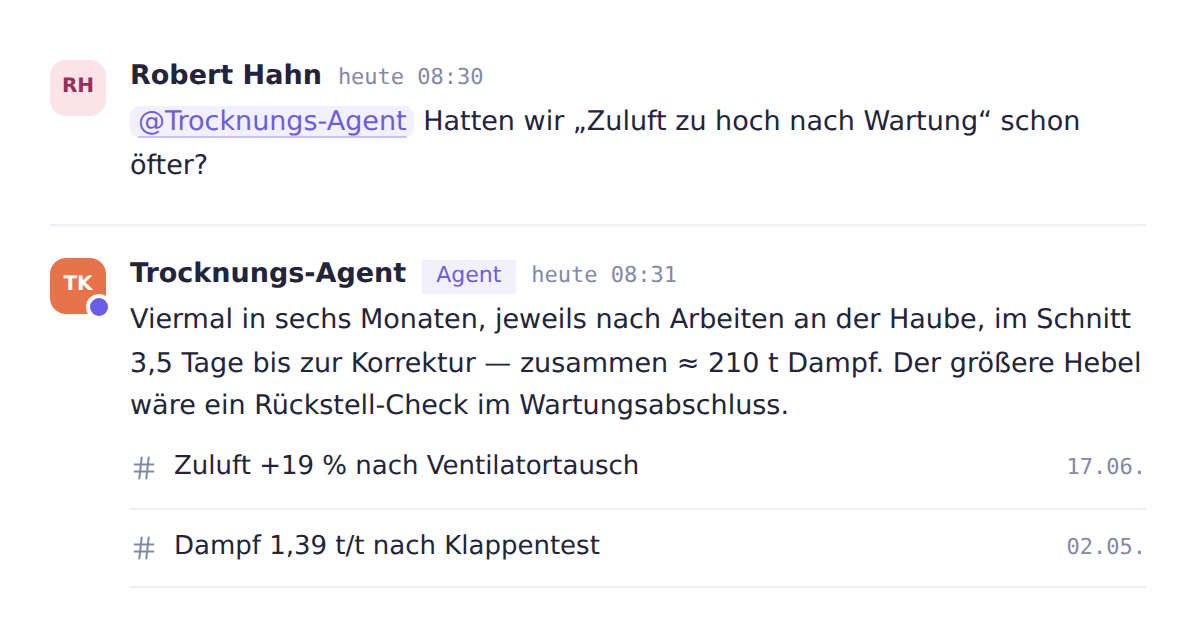
Agents are members of channels, like people, with their own identity and their own key. There is no separate chat window and no form. You mention an agent where the work is discussed, and it answers in the thread, where the shift reads along. Sixteen people and eight agents share the channels of the demo plant.

Thread: a controller asks the drying agent whether supply air was too high after maintenance before; the agent answers with four cases in six months, about 210 t steam, and links the two earlier threads
A question from controlling, answered in the thread. The agent searched six months of channel history and links the earlier cases rather than copying them.
One post, one decision

Agent posts follow a fixed pattern: two sentences of result, one line of effect in the plant's units and in euros per year, and an approval block naming who decides. Everything else, the data, the chart, the tool calls, the sources, sits one click away in the derivation. The channel stays readable for a shift lead with two minutes.

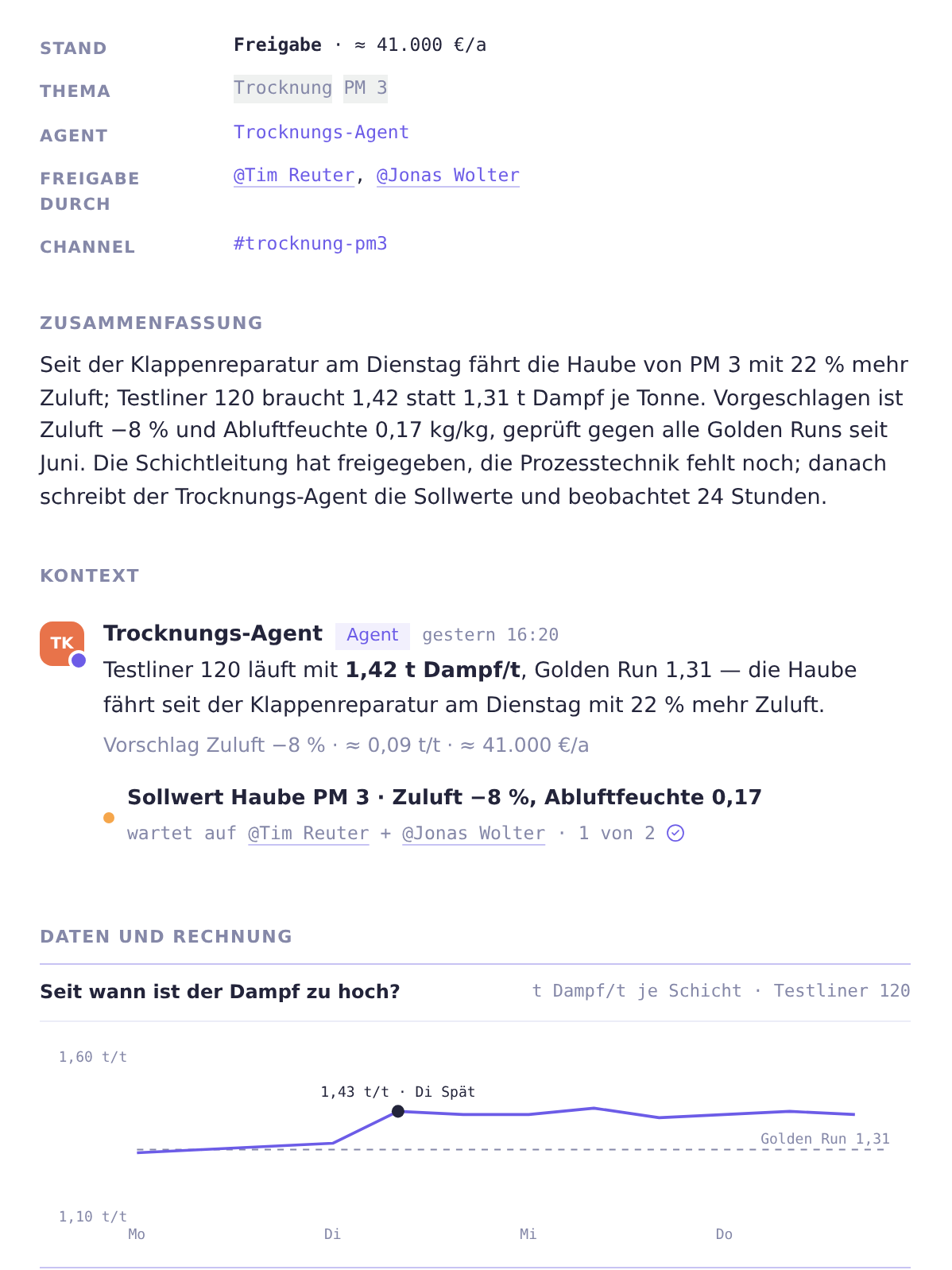
Agent post: result in two sentences, effect line, approval block naming two people 1 2 3
  • 1Result against the reference: 1.42 t steam per tonne where the golden run needed 1.31, and the likely cause.
  • 2Effect line: the proposed change and what it is worth, ≈ 0.09 t/t, ≈ 41,000 € per year.
  • 3Approval block: two named people, one has confirmed, one is missing. Nothing is written until both have.

Each proposal carries its derivation: the summary, the original post, the time series against the reference, the sources with timestamps. The agent's rules forbid estimating a value that does not come from a system. If a number is in the post, there is a meter or a lab result behind it. That matters less for the first proposal than for the twentieth: people approve quickly once they have learned that the numbers hold.

Derivation: status, topic, agent, approvers, summary, original post, chart of steam per tonne against the golden run
The derivation of the hood proposal, with the steam curve since Monday and the golden run as dashed reference.
In the background, via workflows

What has proven itself runs on its own. A workflow is a question to an agent with a trigger, a target channel and the people who approve: four fields, no configuration language. Triggers are a schedule, an event from a plant system, an approval reaction or a mention. The agent posts the answer directly into the channel, marked with the workflow it came from.

Workflows exist at three scopes. Organisation-wide ones are rolled out by an admin and are the same for everyone. Personal ones are created by anyone for themselves, from a question that worked, and can be shared with colleagues. Whoever created a workflow switches it on and off.

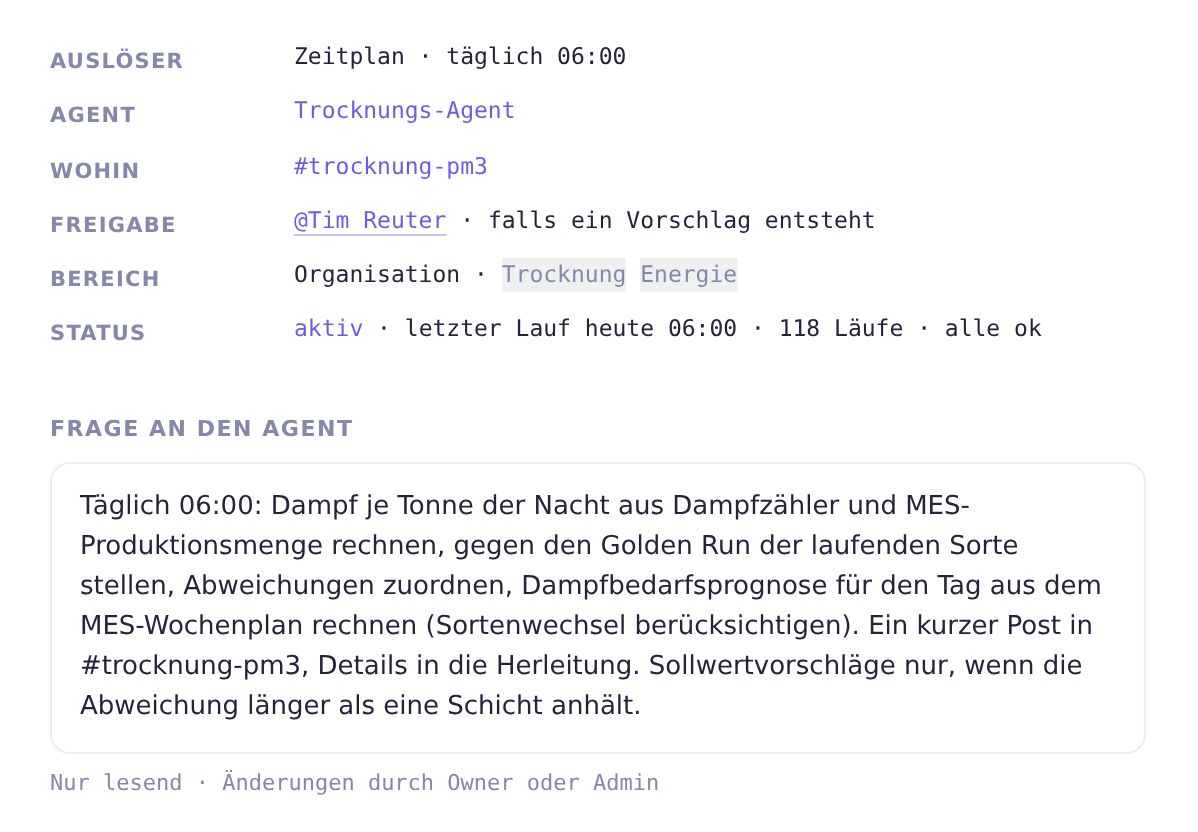
Workflow card: trigger daily 06:00, agent, target channel, approver, scope, status with run count, and the question to the agent in plain language
The daily drying report as a workflow: trigger, agent, channel, approver, and the question in plain language. 118 runs, all ok.
  • ScheduleDaily 06:00 drying report · Wed 14:00 stock report · Wed 22:00 standby report · Thu 11:00 deadlines · 05:45, 13:45, 21:45 handover
  • Plant eventEPEX day-ahead published → dispatch windows · DCS break event → cause within 60 min · MES weekly plan → sequence proposal · change completed → benchmark
  • Approval reactionApproval by the named role → the single write to DCS or MES, with the approval event linked in the audit log
  • Mention@agent in a channel → answer in the thread
Monitoring and approval

Every case follows the same path, and every step of it is visible. The agent does the reading and the arithmetic; people make the decisions; the agent measures afterwards whether the effect actually arrived.

Finding Proposal Approval Implementation Measured effect Agent reads Historian,DCS, QCS, meters. Cause, setpoint,effect in units and €/a. Named people decide.Never the proposer. Agent writes the value,only now, only this one. Meters read again.Actual vs. proposed. agent agent agent agent people The only point at which a proposal can change anything in a system.
  • ApprovalA proposal names the people or roles that decide. Approval is one reaction by each of them. Where four eyes are required, both are named, and the proposer is never one of them. Agents cannot approve.
  • ObservationA write is followed by an observation period defined in the agent's rules: 24 hours for the hood, 14 days with daily lab values for the refiner, with a rollback threshold stated up front.
  • RejectionRejected proposals are confirmed with their reason and not raised again until the situation has changed. The shift lead's "chest 2 at 38 %" stays on the record.
  • InboxEach person sees the approvals waiting for them, answers to their questions, and mentions. Nothing else.
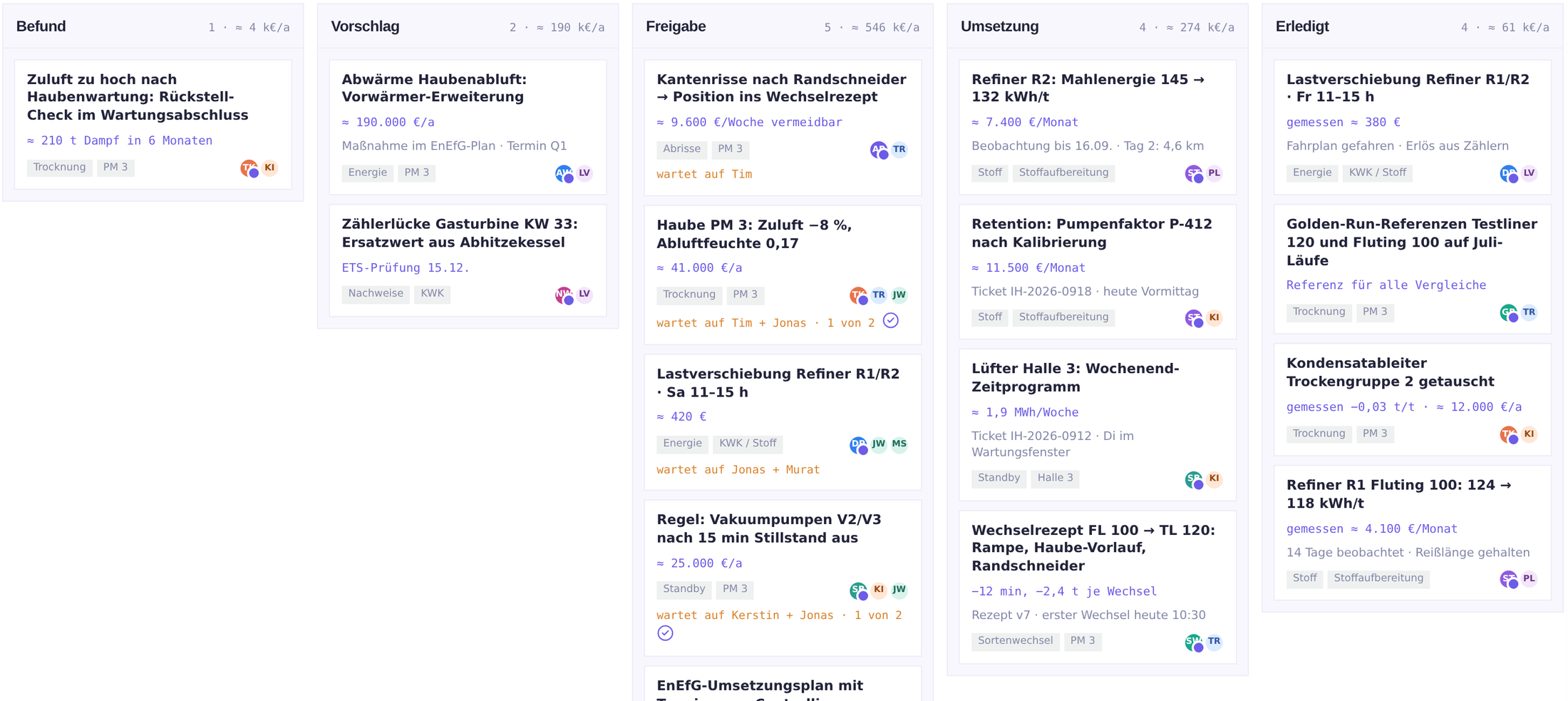
  • BoardEvery proposal is a case on a board and moves as events happen. Column headers carry count and summed effect. The last column is not "done" but "measured": a shift proposed at 420 € is closed at 380 €, from the meters.
Cases board with columns finding, proposal, approval, implementation, done; each card with its effect and the people it waits for
Cases board of the demo plant. Cards name what they are waiting for; a click opens status, summary, context and history, and every history entry leads back to the channel.
03

administration

Administration follows one principle: permissions attach to the identity, for people and agents by the same pattern, and every effect on a plant system is a logged event with a person behind it. The platform runs on your infrastructure. Nothing leaves the plant unless you decide that it does.

Roles and rights

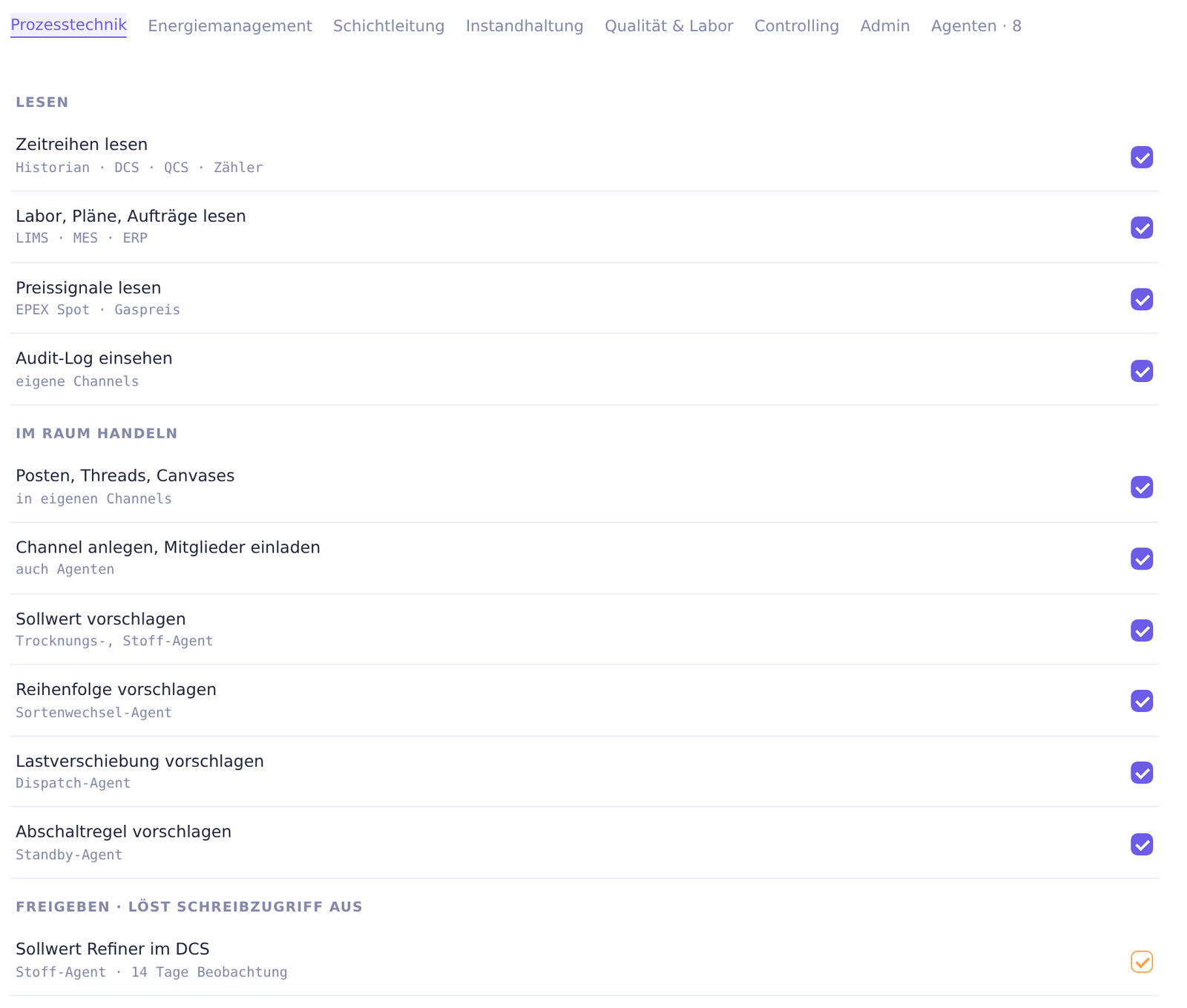
Rights are grouped in four tiers: read, act in the room, approve, administer. Reading and acting are broad; approving is narrow and specific to a system and a write, and it is what triggers the write. Agents form a role of their own with reading and proposing rights and no approval rights at all.

Roles and rights: tabs per role, checklists for read, act, and approve tiers; approvals marked as triggering write access
Rights of the process engineering role. The approval tier lists the exact write each approval releases, and the observation attached to it.
Data connectors

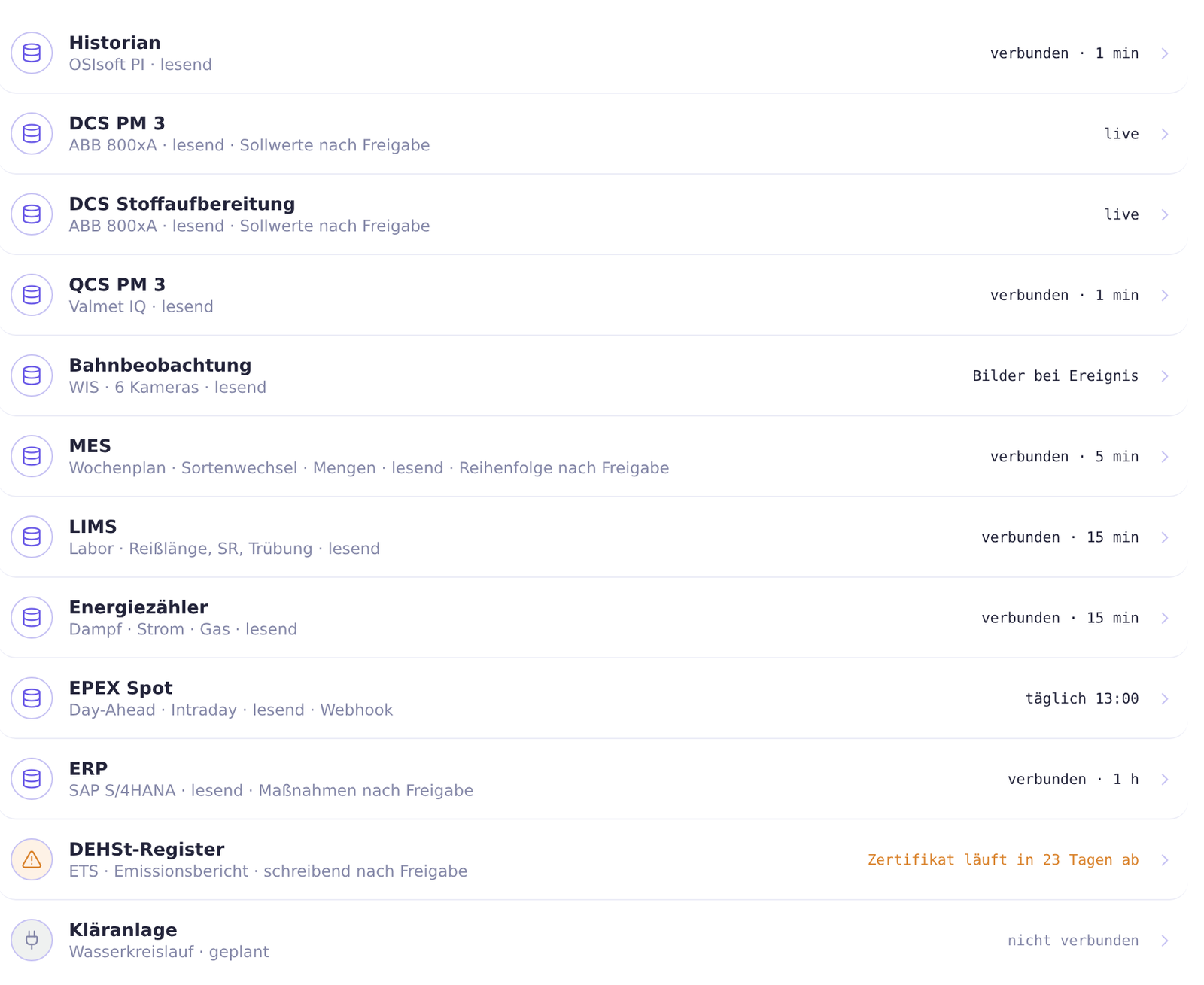
Connectors are attached read-only first. A write path exists only inside a workflow, for one value, after approval by the entitled role. Systems are connected as they are; nothing in the plant is rebuilt for the platform. Certificates and connection state are monitored, and a connector that would pause submissions is raised on the admin start page in time.

Data connectors list: Historian, DCS, QCS, camera system, MES, LIMS, energy meters, EPEX, ERP, emissions register, with read or write-after-approval status
Connectors of the demo plant. Historian, DCS, QCS, MES, LIMS, meters, market prices, ERP and the emissions register; all read-only, three with a write after approval.
Audit log

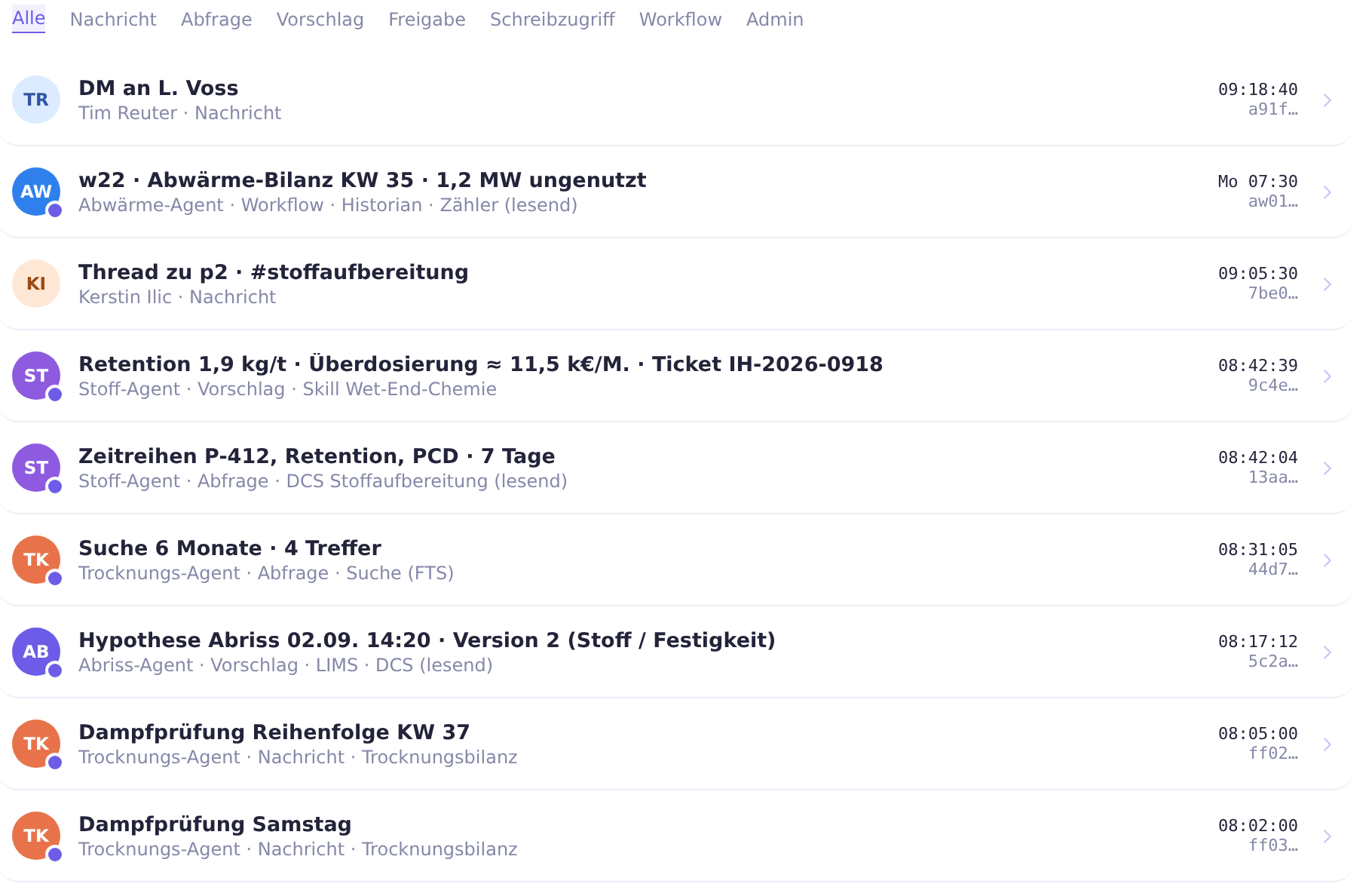
Everything an agent reads, proposes or writes is an event in the same log as the messages and approvals of the people. Events are signed and hash-chained; the chain can be verified and exported. Each event carries the tool used, the data source, the model tier and the cost in cents, and links back to the message or approval it belongs to.

Audit log: events by people and agents in one sequence, each with tool, data source, model and cost
People and agents in one sequence, filterable by event type: message, query, proposal, approval, write, workflow, admin.
Costs and models

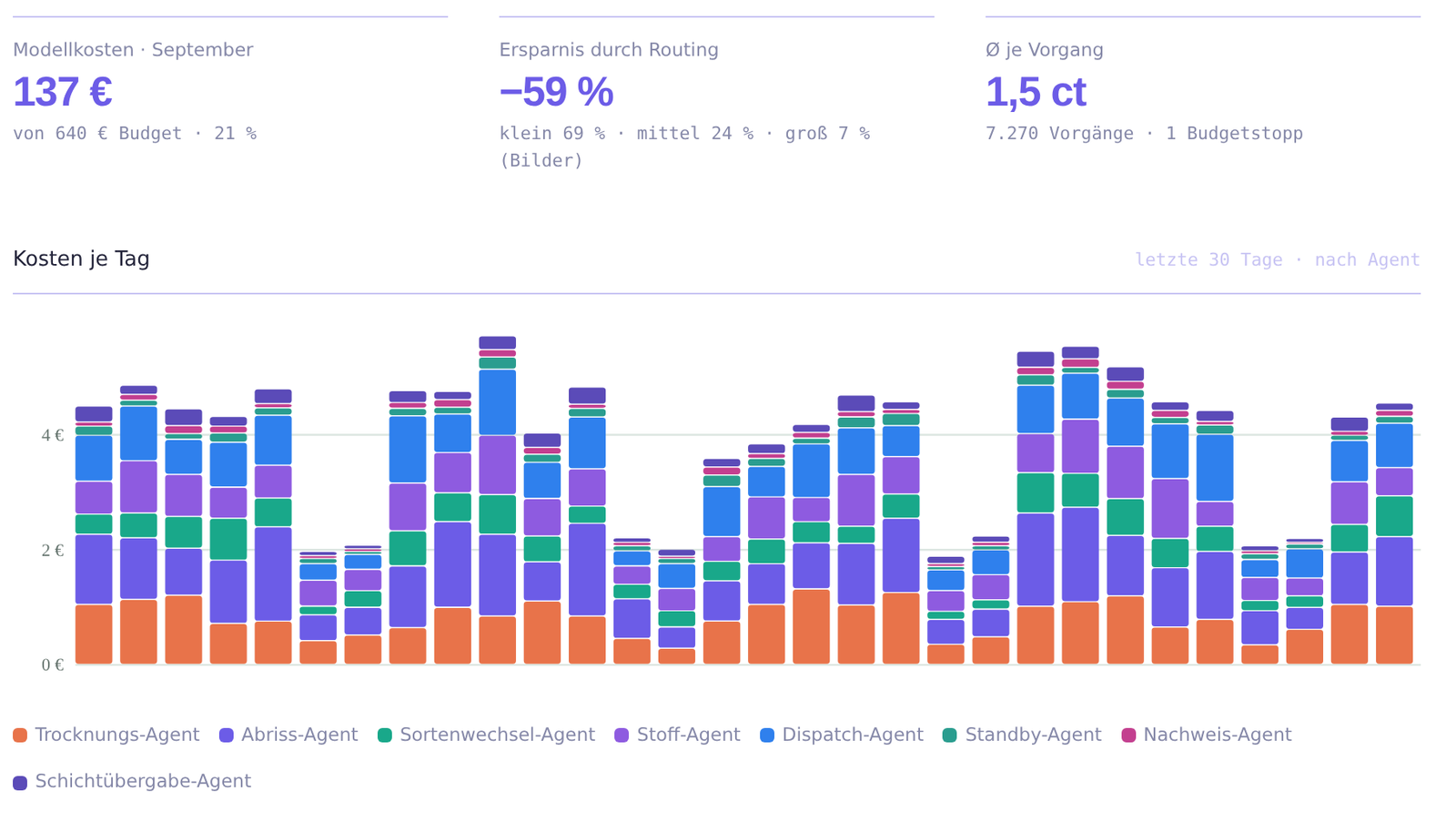
Models are routed per task: small where small is enough, larger for images or long derivations. Each agent has a monthly budget, and the budget stops the agent before it becomes expensive. Every euro of model cost hangs on an event, an agent, a workflow and a case.

Costs: model cost for the month against budget, savings through routing, average cost per case, cost per day by agent
September, demo plant: 137 € of a 640 € budget across eight agents; 1.5 cents per case on average; one budget stop.
Agent lifecycle
  • Prompt and versionEach agent's rules are a versioned prompt in plain language, visible to everyone in the channel. Changes by owner or admin only; earlier versions stay readable.
  • EvaluationAn agent goes productive only after its evaluation suite has passed. Changes trigger a re-evaluation; the result is an event in the log.
  • ScopeOrganisation-wide agents are rolled out by an admin. Personal agents are created by anyone, read-only by default, and can be shared. A personal agent becomes organisational through the same evaluation.
  • DeploymentOn your infrastructure. Model endpoints, connectors and keys stay on your side.